AbeBooks.com. Thousands of booksellers - millions of books.
Feed on
Posts
Comments

A referendum on the HST?

When I was at sea recently – NO, not that sort of at sea, I mean on the ocean – I read a weighty but masterful book called The Life And Death Of Democracy, by Australian historian John Keane who also, incidentally authored a fine biography of Thomas Paine a few years ago. Amongst many things he talks of the “monitor democracy” which has, in addition to the levers of government, outside monitoring agencies such as polling, think tanks, lobby groups and, of course, institutions like thetyee.ca. These have come about because the “system” poses few constraints on a government between elections. It is this fact, of course, that’s led to Recall and Referendum procedures in many jurisdictions, including ours.

Recall and Referenda are seen by many to be dangerous because they often mean premature judgements by voters. The government usually argues that much legislation or policy is unpopular at first and it needs the fullness of time before it can be fairly judged. This is the reason that BC’s rules make it difficult unto impossible to get Recall or Referendum actually to the voting stage. Indeed, I remember interviewing Ujjal Dosanjh after he, as an NDP backbencher, had chaired a Legislative Committee that had toured the province then made a report which told of the enormous support Recall and Referendum had amongst the people then recommended conditions which made both notions all but impossible to implement. When I pointed out this obvious inconsistency Dosanjh just smiled and told me that even though over 80% voted for Recall and Referendum in the 1991 election and the public had voiced their overwhelming support to the Committee, these procedures ought not to be easily implemented! This demonstrates, if more proof is needed, that when politicians piously talk about doing what the public wants done they mean, of course, unless what the public wants done keeps the politician from doing what he wants to do.

That entire process was interesting. The dying Socreds added a Referendum and Recall referendum to the 1991 election process. The NDP under Mike Harcourt were caught in a bind. They knew that the Socreds were playing games. It was, after all, they that did everything they could to avoid Bill Vander Zalm having to face a secret confidence vote at their 1986 convention. Even though the Socreds move reeked of hypocrisy, the NDP believed that they had no choice but to compound that hypocrisy by supporting it. Dosanjh and his NDP colleagues on the committee were on a mission to love the idea to death which they did.

Let us assume that government’s pleas for mercy have merit. What if it `’s not a new policy that has provoked public anger but government deceit by which they won the election they needed to impose their will? Suppose a government suppresses the truth about the state of the government’s finances? What if, during the campaign, the Premier and Finance Minister say that a “harmonized” sales tax isn’t even on their radar screen then do it immediately thereafter? Continue Reading »

Before I get to today’s subject, two respondents to last week’s column asked why the use of SLICE in fish farms protected the Pink salmon yet not the Sockeye. The answer is simple – the SLICE was used by specific farms for specific runs for a short time span when the Broughton Archipelago Pinks went by. Sockeye migrate at a different time from a different river thus had no such protection.

Second, this from my colleague Damien Gillis just back from looking at carnage of the Chilean Farmed Fish collapse:

And so it was to my horror that I read Mary Ellen Walling’s callous take on the Chilean Crisis I had just witnessed. Walling [said]: “Prices are up 10 to 15 per cent over the past six months because of the lack of product in the marketplace…It’s good for the B.C. industry because we’ve got good, solid prices moving forward…There’s a significant lack of Chilean product in the U.S. market. It’s a great opportunity [for B.C. salmon farmers]” Rather like a spokesman for undertakers praising Hurricane Katrina as being good for business! Nice guys these fish farmers!

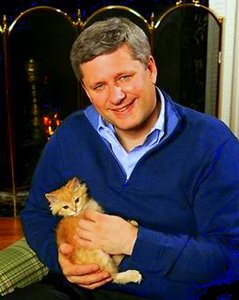
One cuddly cat, our Prime Minister.

One cuddly cat, our Prime Minister.

I took a whirlwind trip to Toronto a week ago and, as always, airplane rides are for contemplation and I began to wonder a wonder – why do we like some politicians and detest others? And how come we tolerate a system where the leader’s wishes trump parliamentary power?

Those who belong to one team or another tend to extend the hand of forgiveness to their leaders’ peccadilloes especially when they’re in government. When a government goes badly wrong though, as Glen Clark’s did, love can shift to hate overnight. The NDP are especially cruel to their fallen angels as Mr. Clark, Ujjal Dosanj, can no doubt attest.

Why, for example do I dislike the Prime Minister; have a gut feeling of negativity towards Mr. Ignatieff; think Jack what’s-his-name from the NDP is OK and rather like Gilles Duceppe of the Bloc.

And why should liking or disliking a leader matter?

Re Harper, maybe it’s because he was always late for my talk show though he knew that a guestless host closely resembles a fish flopping around in the bottom of the boat.

I don’t care for Mr. Ignatieff because he’s shown a massive disinterest in British Columbia and for me that’s fatal.

Mr. what’s-his-name is a decent sort of bloke and his only real failing is that he acts as if he were important? Continue Reading »

A lifelong contrarian

A lifelong contrarian

Those who complain I’m not even-handed don’t get my purpose.

I read comments to this column regularly and both enjoy them and profit from them. In my last article on Federal Fisheries Minister Gail Shea there were concerns expressed that I was not giving equal time to both sides of the issue so I thought I might set out what my mandate is (self-made of course).

To start with, I’m not a journalist in the ordinary narrow construction of that word. The late Denny Boyd once said I was a cross examiner — a misplaced barrister, so to speak. I agree. I’m not an ‘on the one hand, on the other hand’ broadcaster and writer; instead, I am an editorialist. I don’t report news; I give my take on it and invite response.

Last week’s subject was the West Coast fishery and the role of the Fisheries minister. That anyone would argue that it’s her job to promote aquaculture generally and fish farms in particular astonishes me. I quoted former DFO scientist Otto Langer who set out the minister’s duties in stark terms, namely “to conserve and protect fish habitat”. Surely anyone with a rudimentary knowledge of English would understand that statutory mandate clearly excludes shilling for any industry.

If Minister Shea goes to aquaculture conferences surely it should be to admonish the industry and urge them to clean up their act not gush over how important their industry was to Canada.

But back to my mandate. As an editorialist I see it my duty to hold the establishment’s feet to the fire. I say “prove it” when government or industry make promises. I’m a lifelong contrarian. When a government, industry or trade union tells a story my inclination is to say (to myself, of course) “barnyard droppings” or its more earthy equivalent.

Opinion informed by facts

It’s astonishing how often the establishment can’t deal with questions put to them. In that regard, let’s look at the fish farm business, which, for me, started in 2000 when caged Atlantic salmon were escaping and getting into B.C. rivers and streams. My listeners of the day will remember that Dr. John Volpe, a noted fish biologist, and his crew were diving some rivers on Vancouver Island and were finding hundreds of escaped Atlantics. In the meantime, one cabinet minister named John Van Dongen stoutly maintained that only three Atlantic salmon had been found in our rivers — only to be contradicted by his colleague, the late Stan Hagen, who said there were only two!

Then marine biology researcher Alexandra Morton started her examination of the relationship between huge swarms of sea lice attracted to the huge number of hosts in the fish farms with migrating pink and chum salmon. The provincial minister of Agriculture, Food and Fish and the federal minster of Fisheries and Oceans, one would have thought, would have been there alongside Morton getting the truth by scientific tests — but this was from the truth. In fact, the DFO threatened her with jail for illegal sampling! Continue Reading »

Conservative Minister of Fisheries and Oceans Gail Shea

Conservative Minister of Fisheries and Oceans Gail Shea

As BC’s sockeye disaster unfolded, she flogged fish farms in Norway.

Here is the story from the Black Press, scarcely known for left wing tendencies –

The Fraser River sockeye run is winding up and millions of missing salmon still haven’t shown up.

The Pacific Salmon Commission estimates the run size at 1.37 million sockeye – the worst on record and significantly below the last two dismal years, which fishermen had hoped would not be repeated.

Observers see the result as a sign of ecological catastrophe.

And there’s little hope more of the forecast run of 10.5 million sockeye will materialize.

Moreover, as we have long known, several runs of Pink salmon are near extinction in the Broughton Archipelago.

In the meantime, at the height of the collapse of the world renowned Fraser River sockeye, where was Minister of Fisheries and Oceans Gail Shea?

She along with 50 government financed delegates were in  Trondheim Norway attending the world’s largest Aquaculture Conference on behalf of the Government of Canada! When asked by filmmaker Damien Gillis why she was there she said it was because she “supports aquaculture in Canada which is an important part of our economy”. When Gillis tried to video the Canadian delegation he was refused by the Canadian DFO Director for Information because he wouldn’t tell her how he intended to use the film!

Let’s lay some facts on the table here. Sea Lice from salmon farms are killing our migrating salmon including sockeye from the Fraser. As Dr John Volpe, a noted fish biologist  recently made clear. the world’s independent fish biologists “spoke with one voice” and that the impact connection of lice from fish farms on wild salmon is “indisputable”. Minister Gail Shea, on her junket to Trondheim demonstrated beyond doubt that not only did she know nothing of this west coast catastrophe but didn’t care to learn. So we have from the leading scientists of the world that the connection of fish farm sea lice and wild salmon is indisputable” while the Minister in charge uncritically supports the fish farm industry. Clearly, to her, we’re just typical BC bitchers trying to interfere with the legitimate work of government. Continue Reading »

Damien Gillis’ video out of Trondheim, Norway’s recent Aquaculture trade show demonstrates the problem we British Columbians have which simply stated is this – neither of the two major political parties give a fiddler’s fart for the west coast fishery. Fisheries and Oceans Minister Gail Shea simply doesn’t concern herself with our plight and I’ve heard nothing from Liberal leader Michael Ignatieff that he indicates that he even knows that we have fish in this neck of the woods.

This is not an unusual situation. The last Fishery Minister who knew his brief was John Fraser who, unhappily, did not stay in the ministry long enough to locate the private loo.

When I was Environment Minister for BC many moons ago I researched the history of Ottawa and the Pacific Fishery. This history is festooned with short term solutions that lasted only until the next crisis. There were reports and studies galore. Continue Reading »

Dr. Gordon Hartman

Dr. Gordon Hartman

The Hon. Gail Shea,
Minister, Fisheries and Oceans,
Parliament Buildings,
Ottawa, Canada.

Dear Ms. Shea,

Re: DFO’s  poor record for wild salmon protection as opposed to un-restrained support  for salmon farming in B.C.

This is the perspective of two of us who have a combined experience of over 85 years in biology and oceanography – most of this time with DFO. We mention this experience because we believe that it qualifies us, quite well, to comment. We are not alone in the views we hold about the following:

A) DFO – Abandoned Mandate

Historically, we recall times when DFO stood out clearly on environmental issues. These included effective input in hearings on marine oil exploration, research and management initiatives on estuarine fish habitat, research and results application in connection with coastal logging, and strong involvement in the Site C dam proposal.

As opposed to this, DFO’s performance during the past 25 years or so, is lamentable.  Considering Pacific salmon protection the following record is particularly disappointing:

1) ‘Rolling over and playing dead’ in connection with the Alcan and Nechako situation,

2) Sitting quietly by while fish-bearing streams are pre-empted for private power development in run-of-the-river projects,

3) Condoning massive gravel removal in salmon habitat in the lower Fraser River, and

4) Playing hand-maiden to the aquaculture industry.

In regard to aquaculture in coastal B.C., we are deeply concerned about the policy direction and the inadequacy of federal government science. We are concerned not only because the high profile conflict in the Broughton Archipelago area is unresolved, but because the industry apparently wishes to expand beyond where it now extensively operates.

Many knowledgeable people in universities and the public have written extensively about this issue. However, after having seen pictures of DFO’s aquaculture booth at a trade show in Norway, and after hearing your comments to Damien Gillis, we feel obliged to try to help those who would protect wild salmon. We may not understand what has caused the near collapse of the Fraser River sockeye salmon run this year. However, the specter of you at an aquaculture trade show booth in Norway while the Fraser River sockeye run ‘melts down’, has symbolism of DFO’s priority and policy that troubles us.

B) Policy Direction

The behavior of Fisheries and Oceans, Canada, (DFO) is at odds with the department’s own precautionary principle. The department behaves more like an aquaculture promotion organization than a responsibly involved fisheries research and management agency.

Several years ago the Government of Canada established the “precautionary principle” in:  A Framework for the Application of Precaution in Science-based Decision Making  About Risk. (Date modified: 2003-07-25). In the case of the salmon aquaculture business, this policy seems to be ‘far back in the shadows’.

In the salmon net-pen farming industry, particularly in areas such as the Broughton Archipelago, risks and impacts have been documented by research workers outside of DFO. In this situation they show that a “credible case that a risk of serious or irreversible harm exists”.  We have copies of six refereed publications that support such concern. Notwithstanding the precautionary policy aspect and independent, published/refereed research that indicates risk, DFO supports expansion of the industry. Your department is failing in its mandate in three ways:

1) It does not meet the requirements of its own ‘precautionary principle’

2) It straddles two objectives:

a) Managing and protecting wild salmon and,
b) Supporting aquaculture. By the way they are being met, these objectives are in conflict.

3) While being quick to criticize outside research, DFO’s own research provides a weak and fragmentary foundation for management of aquaculture in B.C. (See “Sustainable Aquaculture Research in BC: DFO Publications Related to Fish health and Salmon Aquaculture“).

This failure is even more worrisome given that the aquaculture industry is demanding that it be allowed to move further north along the B.C. coast. If it is not allowed to ‘go north’ then it calls for permission to ‘grow bigger’ where it is. Who calls the tune here?

C) Inadequacy of DFO Science

The DFO has not carried out adequate research to permit a scientifically legitimate management role in the salmon farming industry (see “Sustainable Aquaculture  Research….. Publications … 2003 -2007” above) This list may not be up to date, however, it covers the time period in, or before which, research,  relevant to aquaculture impacts and policy formulation, should have been carried out.

The list of publications includes very few papers that bear directly on the impacts, or potential impacts, of Atlantic salmon net-pens culture on juvenile pink salmon in critical areas such as the Broughton Archipelago. Of 53 titles listed, only five appear to be directly, or partly, relevant to impacts on juvenile pink salmon in the Broughton Archipelago. We are aware that there is more government and non-government research, being planned or carried out now. This is desirable. However, it is unfortunate that this increased effort was not made before the industry expansion was allowed to occur.  With the history of land use conflicts that lies behind us, it is most unfortunate that we still ‘turn business loose’, and then after the fact, try to understand impacts and clean up the problems.

If the Government of Canada, through DFO, continues to require a better assessment of connection between salmon farms impacts and wild salmon population responses in areas such as the Broughton Archipelago, they must engage in ecosystem-scale research that meets or exceeds the standards that they require of others, and that:

1) Extends over a period of time that would permit analysis of the environmental variables that are considered to confound the effects of sea lice,

2) Is enough in control of the experimental situation to permit operation and closure of net pens to provide sound experimental design, and

3) That has funding and people that are independent of political or corporate control.

D) Wild Salmon – Gift of Nature

Salmon culture may now out-produce wild fish catches if simply measured in tons. However, these ‘tons’ come with a spectrum of environmental costs. Furthermore there are important elements beyond such ‘tonnage counting’ in the salmon farming debate.

Culture of farmed fish requires energy, fish food originating in other parts of the world, and it takes space that is useful for other sectors of society. Salmon farms in some locations produce layers of rotting waste below them. We know someone very well who has worked in the salmon farming business – this individual has seen this first hand. Most of the public has not seen it. If the jobs that salmon farming creates are, in the end, offset by loss of jobs involving wild salmon fisheries, their value may be a bitter illusion.

Production of wild salmon does not require all of the ‘front end’ costs associated with food production, energy consumption, freshwater diversion, … etc; that occur in salmon farming. It does, however, require two things: first that we protect their environments, and second that we have the good sense to avoid over-exploiting them. There is an additional benefit to doing these things. The efforts that we make to sustain wild salmon and their habitats also help to support an array of other wildlife. This, plus the environment itself, constitute a positive legacy, beyond the fish, for future generations. Bays full of net-pen farms with material rotting on the sea floor and “Keep Out” signs do not provide such a legacy.

It is clear that wild salmon face a daunting array of man-made environmental challenges, including: other land uses, climate change, forest loss, water abstraction, and ocean condition changes that we do not understand well. This given, your government should protect them as well as possible for as long as possible. This can be done. However, it requires a more sincere concern for wild fish than is evident to date on the part of DFO. In the long term, it requires a vision on the part of elected people and senior bureaucrats that goes beyond winning 2-4 year electoral popularity contests and serving the apparently biggest “business” on the block.

In a long term ecological context, both society and governments must soon come to the realization that human populations and activities must come into some environmentally sensible balance with the limited space and resources of the land.  Humanity will not get to this state of realization and behavior with growth-driven business as its moral and intellectual flagship.

The salmon farming industry and how it is managed is an important part of our future. In this regard, the public is justified in expecting better than has been given. If nothing else, we would ask that your department carry out research that is independent, and that it begin to honor, fully, its responsibility for wild salmon protection in a manner that is above politics and short-term gain.

Sincerely yours,

G. Hartman Ph.D.
C. McAllister Ph.D.

Dr. Gordon Hartman is a member of the Save Our Rivers Society Board of Advisors

There is a coming together of environmentalists unprecedented in my memory and much of the impetus will come from those opposed to fish farms and to the government rivers policy. This is a natural alliance since both deal with rights to water and healthiness of fish although the emphasis might be different from group to group – indeed amongst individuals.

Coalitions are difficult to put together and even more difficult to keep together and wise environmentalists know that. The way to go is find common ground and common assets that can be to the benefit of all. I believe that opponents to fish farms and private power can do much in common with the Wilderness Committee which has done so much to help to help in the rivers cause and against fish farms over the past couple of years. I believe a new umbrella group called the Salmon Circle will play a great role as will the BC Wildlife Federation. If the Campbell autocracy believes the election decided the environmental issues he’s in for a very big surprise.

Oddly enough, in a backhanded way, the victory of the Liberals on May 12 last has made organizing opposition easier. Before May 12 Liberals who opposed fish farms and private power were loath to support the NDP and either held their noses and voted Liberal or stayed at home. This constitutes a large mass of potential support for our cause. Continue Reading »

Roy Jacques

Roy Jacques

I don’t like talking about the “old days”. I try to look at the past for lessons only and look at the world and its future through the eyes of my 29 year old grandson. However I must talk about the past today for the death last week of Roy Jacques, newsman and commentator non pareil should give us all pause for retrospection.

There was a time in BC politics when the “establishment” and the government that represented it (the “establishment” is of the left as much as the right) had to face tough journalists who were experts at holding feet to the fire. These men and women considered that to be part of a journalist’s duty.

Roy Jacques was one of the band of hard nosed commentators that made the 60s through to quite recently a period where the public could really see what was going on. He was a scourge to politicians and those in authority generally. I like to believe that I was part of that band until 2005 but that’s for others to say. What I can demonstrate as a former politician and BC Cabinet Minister is that in days of yore politicians knew that they were under the magnifying glass at all times. (Not on private matters – a politician’s private life was his/her own unless in interfered with duties to be performed).

I didn’t know Roy that well though we knew each other’s work and had spilled a drink together on occasion but he did enroll me and pay for my membership in the International Order of Old Bastards – high praise indeed (I think).

Roy was well known for his no nonsense approach to his craft and his long association with McIver’s Appliance Sales & Service Ltd. I especially remember Roy’s calling W.A.C. Bennett ”the ironmonger” referring to his days as owner of a hardware chain. Continue Reading »

The summer has been a time for reflection for me as Official Spokesperson for Save Our Rivers Society. It was a tough election to lose and I think all involved on the losing side have had much to reflect upon. Now is the time to plan.

It doesn’t take the brains of a Mensa to see that the environmental movement is split into many ways. I’m not talking of the shameful departure of Dr David Suzuki but of the splits within the movement that have long existed.

Those splits, often encouraged by governments, are not bad things in themselves. There are countless points of contact between environmentalists and issues to be concerned about. I must admit that until recent months I thought we should be trying to put together a coalition but I see now it can’t work.

We at Save Our Rivers Society were blessed indeed to have as allies in the recent fight, the Wilderness Committee and their spokespersons, Joe Foy and Gwen Barlee with whom I shared many a speaker’s podium. But WC has a broad mandate and it might have been that other priorities would have made it impossible for them to fight our fight as comrades. Similarly, with our mandate at SORS we might find that our resources were stretched too thin to help WC in a particular issue. But this makes this point – what if environmental activists simply got one coordinating point so that, for example, when WC would like support, the coordinator could canvas other groups and see what help they could spare. Continue Reading »

When you’re a common scold as I am it’s  too easy to lose sight of the main message when the cause expands to include so many issues. I have, I fear, been so afflicted and have unwittingly passed the problem on to you.

When I joined Save Our Rivers Society in May of 2008 I did so because rivers like the Pitt were about to be assassinated by greedy speculators and prospectors whose rewards from the victim’s remains were unconscionable. As with so many things in life, every newly overturned stone revealed yet another nasty crawly thing.

Now don’t get me wrong – these other issues are extremely important. The slow but certain strangulation of BC Hydro is of immense importance. Forced to forgo making new electricity and compelled to sign extravagantly rich deals with private power companies, there is no way BC Hydro can continue in business for long. No company can buy product for 2 to 3 times what they can sell it for can last.

I believe that I would be wrong not to point out to fellow British Columbians what BC Hydro has meant to us all – cheap, available power  and since the environmental sacrifices of the 60s and 70s, truly green power. I would not be doing my job if I didn’t tell people that while BC Hydro has, hitherto been able to place 100s of millions of dollars into the public treasury every year, that because they must now pay the contract prices extorted out of them, with Campbell’s blessing, indeed help, that dividend will no longer be there.

Could I have dealt with this issue properly without noting that the majority of private power will not be used for us in BC but sold into the US market by BC Hydro at a huge loss? Could I have avoided telling people that when Campbell & Co told us that  we are net importers of power, and that the proposed private power would make us self sufficient by 2016 that they were lying through their teeth? Wasn’t it my job to show how Campbell selectively used BC Hydro statistics to show BC as net importers when the real story from the National Energy Board and StatsCan showed that when you include all producers we are a net exporter?

Wouldn’t I have been negligent indeed not to point out that by BC Hydro’s own figures backed by independent experts show that  British Columbia can with conservation, updated generators, new generators especially on flood control dams and taking back, as we’re entitled to do under the Columbia River Treaty, power we now export, be self sufficient for as far as the eye can see?

Didn’t it need to be said that the environmental assessment process is a farce. Wasn’t it apropos to point out that we the people have been denied all power to express our opinions on the “merits” of these projects?

And wasn’t it essential to point out that in spite of what independent power producers would like us to believe, the gas fired Burrard Thermal Plant is there for backup only and used but a few days a year? Continue Reading »

« Newer Posts - Older Posts »