AbeBooks.com. Thousands of booksellers - millions of books.
Feed on
Posts
Comments

I want to expand a bit on what I said on the Political Panel this morning (August 30) on the CBC.

Although it may seem ephemeral, a government’s attitude is important – very important indeed. The Liberal government hates social programs and it shows.

This morning my remarks were dealing with parks but they cover the entire system of government.

I don’t wish to be misunderstood here. Of course governments have as their principal duty the careful handling of public money. We have, however, long ago decided upon a welfare state in the best meaning of that term.

It started back in the very early years of WAC Bennett’s reign (and reign it certainly seemed to be) when he brought in a sales tax to pay for his Hospital Insurance scheme. British Columbia under WAC Bennett was also amongst the first in Canada to have a form of Medicare. These things don’t look very important now but in the 1950s they certainly did. Bennett didn’t do these things because he had to but because they each were the right thing to do.

This attitude of service to all British Columbians, not just your supporters, continued and was expanded by the Dave Barrett government of 1972-5 as it was later in Bill Bennett’s time. Continue Reading »

Let’s take a trip down memory lane today – my memory lane anyway, for I suspect that a lot of you weren’t even gleams in your father’s eye in the 1950s.

In 1961 I was in my 30th year – it was the year I articled with the late Tommy Griffiths and was, on May 15th, called to the bar. It was also a year when an amazing performer from Oz. Rolf Harris was in town for a gig at the Arctic Club. In fact, earlier he had lived in Vancouver for nearly a year.

A word about the Arctic Club.

Cocktail lounges didn’t come to Vancouver until The Sylvia Hotel, built in 1912 as an apartment house, opened Vancouver’s first “cocktail bar” in 1954, Prior to that, the only public drinking holes were “Beer Parlours”, ghastly places now that I look back but, as they say, any old port in a storm. (Later, in 1978, as Minister of Consumer and Corporate Affairs, I ended these dumps with the creation of the Hotel “Pub” license). Continue Reading »

Is Tiger finished (II)?

Can Tiger come back now that his divorce is final, Elin had been paid off and the children suitably dealt with?

There is no question that his self confidence has been impaired if not shattered and that his steely confidence has, until now, screwed up the heads of his opponents. The cock of the walk is now an ordinary bird, no longer with the flock deferring to him. He’s lost some huge sponsors and, I suspect, the only reason Nike hasn’t shown him the door is because they have too many golf balls and sportswear with his face on them.

The questions are these – has Tiger lost his swing? Has he lost the mental toughness that made opponents creep? Is he in financial trouble? Continue Reading »

This week, biologist Alexandra Morton announced that she has learned that the fish farms in the Broughton Archipelago are on leases that have long ago expired. In a move combining defiance and a wicked sense of humour Alex has applied for the leases which she will devote to returning the ocean bed “to their natural state to grow wild fish to the much greater benefit of British Columbians and the BC economy”.

This Crown Land is public land that the Ministry of Agriculture and Lands (MAL) leases to people and companies. MAL is also in charge of regulating the salmon feedlots. Even for this government, the arrogance is breathtaking.

What sort of hold have these Norwegian fish farm companies got on this government? What is the explanation for this utter and absolute giveaway of Crown land to foreign companies to use virtually free while their operations wipe out wild salmon stocks year after year? No one, least of all I, would accuse this government, its leader or any member of it of corruption but it must be said that if these circumstances prevailed somewhere else, in the absence of a rational explanation, one would have to suspect hanky panky of some sort. Continue Reading »

Five ‘vectors’ spell doom for once-solid Crown corporation. Blame Campbell’s energy policies.

Erik Andersen is a former Transport Canada economist with a long and interesting pedigree of examining the affairs of business and government. He has done a report for The Common Sense Canadian — I am a co-founder and regular contributor — on the state of BC Hydro.

The picture he paints is of a once rock solid Crown corporation placed on the road to fiscal ruin by the Campbell government.

Andersen was asked to examine BC Hydro’s fiscal situation, especially in light of the contracts they have been forced by the Campbell government to enter with Independent Power Producers (IPPs).

Andersen’s report, entitled “Sinister Financial Vectors at BC Hydro,” examines a number of “vectors” which “give information and direction and the magnitude of a changing position.”

Five such vectors, concludes Andersen, indicate the financial position of BC Hydro is headed dangerously downward. Those vectors are:

Operating net income: “In the four year period (beginning with fiscal year 2007) there has been a $628 million reversal of net operating income.”

Recorded demand: “Expressed in GWhs (what BC Hydro sells) total volume of domestic (inside B.C.) sales went from 52,440 in 2006 to 50,233 units by 2010. After five years at the 52/53 thousand levels, demand dropped away sharply in fiscal 2010.”

Ratio of debt-to-equity: “A ratio of 100/0 can be evidence of insolvency. At BC Hydro this ratio had traditionally hovered around the 70/30 mark. The 2009 Annual report showed a remarkable change to 81/19. After calling upon the ‘regulatory account’ for the 2010 year the debt-to-equity ratio is now presented as 80/20. If the ‘regulatory account’ transfers were stripped from the BC Hydro financial statements, the ratios for 2009 and 2010 respectively would be 87/13 and 89/11.”

Productivity (a measure of whether shareholders are getting value for money): “In fiscal 2007 about $236,000 of capital was used to produce one GWh. By 2010 it took 38 per cent more capital to get the same quantity of energy for domestic customers. By this evidence it looks as though the system is becoming less efficient. Liabilities also mirrored this vector.”

New and expensive contractual obligations associated with the call for power from Independent Power Producers (IPPs): “The 2010 Annual Report BC Hydro states that ‘During fiscal 2010, IPPs provided 8,893 GWhs of energy to the BC Hydro system, which accounted for about 16 per cent of total domestic electricity requirements.’ A Dec. 2009 report from Price WaterhouseCoopers projects that existing and potential IPP projects will deliver 35,470 GWhs by 2020. The estimated total capital deployed would be $26.144 billion. That translates into $737,074 of new capital to produce one GWh or 126 per cent greater than the already elevated 2010 level. Amazing!”

Andersen’s conclusion? “As the evidence of need for more electricity is not apparent, the aggressive borrowing/investing/contracting with IPPs is clearly wrong.”

In the same report Andersen describes, “BC Hydro borrowing/spending (on IPPs)” as “irresponsible of Hydro’s Board and management as it has increased the risk of financial insolvency.”

He points out that “Hydro is paying IPPs more than double the open market rates” and that “from now to 2020 new IPP producers will use more than double the capital now used to produce a single unit of saleable energy.”

To rub it in even further, BC Hydro will no longer be able to pay its annual dividend of hundreds of millions to the B.C. government, money which went for schools, hospitals, etc.

Ideology trumps business sense

There it is — ruined rivers and their ecosystems for power we don’t need and can’t use. Power profits going to IPP-investor entities beyond B.C., including Warren Buffett and General Electric. And an iconic crown corporation, BC Hydro, hurtling towards bankruptcy, all thanks to Gordon Campbell and his hard right fiscal philosophy.

Just to be clear, Andersen is a “contributor” to The Common Sense Canadian along with about 25 others whose backgrounds vary as much as their politics, ranging from academics considered, at least by the Campbell government, as “left” to Conservative MP John Cummins and independent MLA Vicki Huntington. Andersen and other contributors to the site do not get any remuneration whatsoever.

The visionary Socred premier W.A.C. Bennett saw that if B.C., with a growing economy, was to compete and prosper, it must have reliable — and cheap — power. He knew that private companies would be concerned with profit only. (He created BC Ferries and BC Rail for the same reasons, both of which have been privatized by the Campbell government).

Bennett developed his “Two Rivers” policy, putting large dams on the Peace and Columbia Rivers. B.C., and especially those who lived in the areas affected, paid a huge environmental price but we got what he bargained for.

B.C. can be power-sufficient for years to come by exercising the conservation projects of BC Hydro, by upgrading existing generators, by placing generators on “flood control” dams and by taking back our power we now export under the Columbia River Treaty. The Campbell government has chosen to ignore these uncomfortable facts, one can only assume for ideological commitment to private power.

By all rules of decency the Campbell government must resign, having, as Andersen’s vectors show, planted the seeds of destruction in the bowels of BC Hydro.

For starters, and just for the record, here are Rafe’s three axioms of politics.

I.      You make a serious mistake in assuming that people in charge know what the hell they’re doing.

II.    You don’t have to be a 10 in politics, you can be a 3 if everyone else is a 2

III.   Never deliberately create an unpopular issue that will still be there on the next election day

Let me get ahead of myself with an illustration of the operation of Axiom III from when I was in government.

The Bill Bennett government, of which I was a member, came to power on December 22, 1975. The Barrett government that we had replaced had created the Insurance Corporation of BC and in a year and a half, with a monopoly on car insurance, had managed to lose $186 million. The provincial cupboard was bare. Continue Reading »

The Republicans will slaughter the Democrats next November according to those who know about these things. And I’ve no doubt that they will. All the House of Representatives and 1/3 of the Senate are up for grabs and the Democrats are in bad shape and could even lose control of the Senate.

I will take these prognostications and predict that in 2013 President Obama will win re-election handily.

How do I square that circle?

By 2013 the public will be able to see Obama in perspective.

I believe that Obama has done very well. Consider what he inherited in Afghanistan, Iraq and the US Economy.

It’s been well said “it’s the economy, stupid!” Let’s examine that. Continue Reading »

More on legalized theft

Please tell me that I haven’t gone mad. Tell me that people in this province really do care for their environment; that they want to continue with public power through BC Hydro.

Thanks to the work of Economist Erik Andersen, we now know that Gordon (Pinocchio) Campbell has set BC Hydro on the road to bankruptcy. We have had confirmed what Damien Gillis and I have been writing and saying for 2 ½ years; BC Hydro has been forced into giving Independent Power Producers (IPPS) sweetheart “take or pay” contracts requiring Hydro to buy power it doesn’t need thus must sell for ½  of what it paid. We’ve also seen that IPPS account for 16% of Hydro’s domestic power meaning Hydro has bought hugely expensive power that it can produce itself for a fraction of the cost. We also know that the substantial dividend Hydro used to pay the BC government each year is gone – unless they charge us higher rates so they can pay it back to us! Continue Reading »

Posted on thecanadian.org you will find a report on BC Hydro by economist Erik Andersen, Sinister financial vectors at BC Hydro, and it should shock all British Columbians. I must add that I feel vindicated since I’ve been saying these things for 2 ½ years based on inferred evidence fortified by the lack of rebuttal by BC Hydro, the private power interests or the Campbell government.

The situation Gordon “Pinocchio” Campbell has got us in is all but impossible to believe, but he’s done it.

Let me quickly lay out why we have a publicly owned power company.

Back in the late 50s and early 60s then Premier W.A.C. Bennett made three decisions – he decided that Black Ball Ferries, being privately owned, would never serve any communities unless it was profitable; he decided the same thing for the old PGE railway; and he held that BC needed an abundance of cheap power for both industry and the general public so he nationalized BC Railway in 1961. Thus we had BC Ferries, BC Rail, and BC Hydro and Power Authority. Continue Reading »

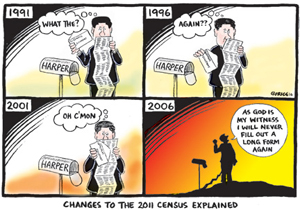
Cartoon by Ingrid Rice.

Cartoon by Ingrid Rice.

They never say why they need so much info. I just don’t trust them.

Gadfrey Daniel! I’m on the same side as Stephen Harper, the Canadian Taxpayers Federation and Gadfrey Daniel! once more, the Fraser Institute! I say NO to the census “long form.”

I must say, without intending to hedge, that my opposition takes the form of simple questions.

Why do you want this information?

What specific purpose is it used for?

Is this to get information at taxpayers’ expense for corporations who could get the same information on their own dime?

Is it, more likely, information they badly want but have no way of getting with any certainty it’s accurate unless it’s extracted from citizens under duress?

Let’s get down to cases with a few questions to the census man/woman.

If you aren’t going to disclose anybody’s name, why then do you need it?

Why do you need my telephone number unless someone is going to call me — like a telemarketing company?

Why do you need to know who stays in my place, including children, by name? Is this so telemarketers know that mine is a very good place to sell kids clothing or family lifestyle magazines? Or if there are no children, peddlers of dentures, prosthetic devices and electric carts?

Why do you want to know whether people who live with me are foreigners? Might I expect a visit from the immigration people?

Too personal, step away

You ask highly personal questions about people staying with me, including their relationship to me and if they’re living common-law, plus much, much more. Why do you need this? What use will be made of the information? Just on the common law question — of what earthly business is it of yours what relationships people have with one another?

Remembering that the names and details of my guests will now be known to you, why do you need to know about their mental health problems?

What business is it of yours where my guests were born, including whether or not they are landed immigrants and if so, when they achieved that status?

Am I doing investigations for the immigration department?

What possible right have you to know my guest’s religion? What use will you make of that information? To be peddled to religious nuisances who pound on the door and interrupt one’s Sunday hangover?

Why, unless you want to send them a birthday card in their native tongue, does the Canadian government demand that I demand information from my guests on the basis that I might go to prison if they don’t give it to me?

Since French and English are the official languages of Canada, of what interest is it to Ottawa what other languages are spoken unless, of course, this information is sold to telemarketers?

Ancestors? Who cares?

Why should I tell you how much income I made and how much tax I paid?

Are you seriously asking me to believe that this information will not be sent to the tax department? Am I to trust you? Be prepared for a surprise — I don’t!

You really get personal about my ancestry and religion. Of what concern is it of yours what my ancestry is? Dealing with religion, what’s it to you? You want to know all about my parents. What possible reason can you have for that? They’re not likely to either need help from the government or cheat it since they’re both dead.

It’s interesting to note that the information about “race” goes to the people who administer the Employment Equity Act. Does that include names and addresses? Who gets this information — the lowliest clerk in the department?

You want to know where people living with me lived five years ago, a question I might find too personal for even me to ask of them. Is this information for municipal governments to help them to identify “illegal” suites?

Reason being?

Before I answer a lot of personal questions, under penalty of prison if I don’t, just tell me, question by question, why you want this information. I base this request on the notion that my privacy cannot be invaded unless good reason is shown. This “good reason” is not satisfied by saying that we have “good reasons.”

Your whole case seems to be “we need the information” and “trust us.”

That’s not good enough, and I don’t.

Those who have set their hair afire over the abandoning of the “long form” say that in surveys, people don’t object.

Okay, not for the first time, I stand alone as an objector and do so on principle — the principle being that almost everything government wants to know about me is none of their damned business.

It’s often said, “If you have nothing to hide, why worry?”

I worry because I do have something to hide — my privacy!

I have that old fashioned notion that if someone demands information from me, they must at the very least tell me why they need that information and what use they will make of it.

Is that too much to ask of our government?

Governments are generally so untrustworthy we must have ombudsmen, privacy commissioners, auditors-general and conflict of interest commissioners to protect the interests of the lowly citizen. We have these and other people in place for one simple reason — governments habitually break trust with the citizenry. Why would they be any different in this regard?

Numbers for everyone

I remember when the Canada Pension Plan was introduced, we were told that whatever information we gave the government would just be our little secret. In no time, the SIN number was required for ID by almost anyone you wanted to do business with.

If the long form census — indeed the short form for that matter — requires personally identifiable information, Canadians are entitled to know, in detail, what that information will be used for.

If I’m asked, “Do you not trust your government?” my answer is a plain, unequivocal NO. Why the hell should I?

« Newer Posts - Older Posts »