AbeBooks.com. Thousands of booksellers - millions of books.
Feed on
Posts
Comments

Lewinski, Clinton

The intern, the president... and off screen, a dark Starr.

‘The Death of American Virtue’ is a cautionary tale of justice and libidos out of control.

If you are like me, you found the whole business of president Clinton, Whitewater, Ken Starr, Paula Jones, Monica Lewinsky and a large supporting cast tiresome as it wandered on, but I can assure you that this book is anything but tiresome.

In fact, it gives Canadians an intimate look at the American “justice” system — inverted commas deliberate.

This matter began with an investigation by special counsel Kenneth Star, a first class litigator and master of Constitutional law, into the handling of a relatively small set of real estate deals in Arkansas which involved Bill and Hillary Rodman Clinton. Fifty-two million dollars later, it resulted in impeachment proceedings against Clinton in the Senate, for only the second time in history. (The first, Andrew Johnson in 1868 is well told in John F. Kennedy’s Profiles in Courage).

The Whitewater saga was constantly visited by a deus ex machina, Paula Jones, who alleged that when he was governor Clinton had exposed himself to her in a hotel room.

What did this have to do with Whitewater?

Damned if I know, but I can tell you she mattered. In this sideshow, Jones turned down an offer of settlement (well you might ask what why?) of $700,000, lost the case and later as the case went to an appeal that looked sure to fail, took a settlement of $850,000! Jones constantly said that she didn’t want money, just her reputation restored, which is like when someone says, “It isn’t about the money… it’s about the money.”

Balls in the air

One of the stories within the story actually does come from Whitewater — the saga of Jim McDougal and Susan McDougal, two of the principals in the cruddy little land deal that cost so much and hurt so many. He died in jail and she went to jail for not cooperating with Starr’s meandering investigations.

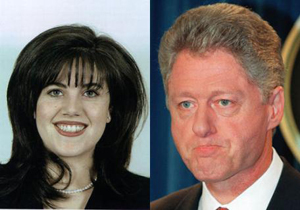
Then of course there was Monica Lewinsky, whose antics with Clinton in the White House led to my observing to my audience that “young men forevermore must be grateful to Clinton because never again will they have to explain to a young woman what a blow job is” (feel free to use that line). After reading this book I had a better opinion of her than during the saga. Yes, she lied under oath but in the circumstances, who wouldn’t have? She was pilloried by the media as if she alone was responsible for what happened.

For me, this book has three features — the careful weaving of several stories while never impairing the reader’s interest, the U.S. legal system, and the strange case of Bill Clinton.

The historian’s most difficult task may be the keeping of a great many balls in the air at once. A common irritation about reading history, especially political history, is always having to retrace your steps several chapters to find out just who we’re talking about now, then realizing that you’re still not sure who the devil is who. Author Ken Gormley masters this problem skillfully.

Here, I should disclose that Gormely is an old friend, though we’ve never met face to face. He was my guide and a first-class one on American politics when I was in radio. In fact he and I, against the run of current opinion, accurately predicted that the Democrats would do well in the 1998 mid-term elections, not lose their ass as Republican house speaker Newt Gingrich had predicted. Ken had more expert reasons than I did — I just didn’t believe that because Clinton had been caught at salacious conduct that was grist for magazines at the supermarket pay station, voters would penalize his party. In fact, amazingly, throughout this entire mess Clinton maintained terrific polling numbers! On the other hand, Ken Starr did not.

Which brings me back to feature on of Gormley’s book: The U.S. legal system, and what we can learn from it here in Canada.

The politics of judges

I’ve long been in favour of opening up our legal system and, for example, examining prospective judges in public. I think I still favour this but not if it leads to the system Gormley exposes.

Maybe we Canadians kid ourselves when we assume that appointed judges are fair and impartial in spite of which government appointed them, but do we want a system where major decisions (George W. Bush’s first election for example) are made along party lines? Or, if not, seem to be?

Clinton, throughout, was concerned about the politics of judges, especially when the Senate hearing on the impeachment proceedings, was chaired by Chief Justice William H. Rehnquist, a doctrinaire Republican. In the event the chief justice, not being a judge but a chairman in these proceedings, displayed a strong sense of the history being made and the necessity that he should appear and he fair.

Nasty tactics

What disturbed me even more is how the prosecution could and did use inducements and threats to witnesses for their cooperation. Monica Lewinsky, especially, was victim of this prosecutorial rack upon which she was stretched every time it was thought she might waver.

The number of lawyers on Kenneth Starr’s team seemed countless and his use of “horses for courses” when saying which minion would perform which task, offended this old lawyer who practiced when “the Crown neither won nor lost” but put the Queen’s case “thoroughly and fairly.”

I was not only stunned by the numbers but the constant search for winning techniques. Starr was like the coach in the locker room chalking plays onto the blackboard. I got a very strong sense that if this was American criminal law procedure, thanks but no thanks.

In the result, $52 million later, the prosecutors blew it and it staggers one to think it was such an elementary thing — they did not prosecute president Clinton for perjury and obstruction of justice, (one feels sure they would have got a guilty verdict) before they tabled the Starr Inquiry in the House of Representatives, complete with a road map for the passing of a Bill of Impeachment. If the Senate had judged the impeachment on the basis that Clinton was a convicted perjurer, the Republicans would surely have got the two thirds majority needed.

Wardrobe malfunction

There are, of course, two main players, Kenneth Starr and Bill Clinton. My sense of it was that Ken Starr is a highly competent lawyer whose long suit isn’t controlling events he’s in charge of. The fact is he was prosecuting what the British would call a “tuppenny, ha’penny” case that morphed into several others, a case which became a runaway fire storm threatening the presidency of a man considered a good one even by his enemies. Starr’s aura of decency, fair play and indeed balance was challenged by his behaviour when he was set to prosecute Clinton after the Senate acquitted him!

Ken Gormley doesn’t tell us what kind of a man Clinton is but leaves that task to the reader — where it belongs. Gormley is a Democrat but is a straight-shooting historian, as those who read his previous book Alexander Cox: Conscience of a Nation will know. (One complaint, the book could have used a table of characters with an explanatory one paragraph précis, so many and varied there were.)

A brilliant man in many ways, Clinton’s extra-marital indiscretions make Tiger Woods look virginal by comparison. In fact a comparison to Woods is apt in that both were brilliant and masters of their craft. Both of them gambled careers and character not on an irresistible love for a soul mate, but for tawdry affairs with instant gratification being more important than spouse, reputation and life’s work.

This book at 690 pages is long, but understanding the story of the rise, fall and resurrection of William Jefferson Clinton does not lend itself to brevity. Despite its length, the book is a page turner as Ken Gormley brings all the side shows on to the main stage where the most powerful man in the world and a hugely popular president was almost toppled because he couldn’t keep his pants zippered up.

I was a paper boy for The Province, and to this day, can’t wait to read certain pages.

It’s been suggested by an emailer that I hate Canwest!

Egad, a base canard as I shall demonstrate!

When I was a lad, I belonged to the Tillicum Club organized by The Province. You got a neat genuine fake silver totem pole to wear and a secret password, Klahowya, which was only to be used by Tillicums. I was a paper boy for them too. The Tillicum Club always put your name in the paper on your birthday and it doesn’t get more exciting than that. The Province doesn’t put my name in their paper any more.

The Vancouver Sun had its Uncle Ben Club but we Tillicums wouldn’t have anything to do with them. They didn’t put your name in the paper either. Actually, I should be careful there because good Tillicums didn’t dare look at Uncle Ben so I probably didn’t check it out.

My correspondent suggested that I probably resented being fired by Canwest and boy does that get my dander up! I wrote for Canwest (The Province) for a couple of years and I fired them!

What happened was that Canwest fired the publisher of the Ottawa Citizen after he did not agree to run an editorial written by people at Winnipeg headquarters and distributed to every Canwest paper. The day after the publisher gave a speech defending his position, he was turfed. My pal Gordon Gibson in his regular column for the National Post, the Canwest lodestar, was critical of the decision, and they wouldn’t print his column. I, then, in solidarity with Gibson, declared on my show on CKNW that I didn’t want to write for a company that censored its writers and therefore I resigned. *

It got nasty. The Province told CKNW management that if they didn’t shut me up they would withdraw their advertising. I wasn’t supposed to know about this but management had a leak and I did. I told my audience about this and suggested that just as those who didn’t agree with me could change stations, those who disagreed with Canwest should tell them that in the traditional way; cancel their subscriptions. Evidently many people did just that. The unpleasantness went on for some time.

Many firings along the way

Now I wouldn’t want you to think that I haven’t been fired from time to time. I have the distinction of having been fired twice by Jimmy Pattison (not him personally, we’re friends) but his radio stations and by the owners of CKNW. I was fired by the Black newspapers too and by the NOW chain. Then there was the North Shore Outlook and a family periodical whose name I’ve forgotten. I also wrote for the Vancouver Courier, which I left in order to go to The Province, but that was a very amiable parting which I later rued but they eventually were owned by Canwest so who knows what would have happened if I’d stayed? (Come to think of it, I think I know what would have happened!)

My current outlets

I also wrote for The Georgia Straight whom I left on the very best of terms to go to the Courier. I keep writing their editor to offer them another column but they don’t reply. I’m not quite sure what that means. I’ve written for The Tyee since 2005 and though the temptation must have been great sometimes, they haven’t fired me yet. I also write for a Russian online paper called the Strategic Culture Foundation. It’s got good stuff in it and no, I’m not in Russian. They publish in six languages including English. Then there is The Common Sense Canadian and www.rafeonline.com, my own website for whom I do regular blogs.

Now I wasn’t quite accurate about Canwest, for I guess they did fire me once. When they bought out The Financial Post, for whom I had written for several years, they simply sent my column back saying they had no further need for my services which, while effective, might be seen as somewhat abrupt considering how long I had written for them.

Actually, many years ago The Globe and Mail offered me a column on the op-ed page and when I told Diane Francis, then editor of The Financial Post, about this she got very angry and substantially increased my fee. (That’s never happened to me before although it has sometimes been the other way around).

I’m sort of proud to be a writer who’s actually rejected an offer from the self styled “Canada’s National Newspaper!” I was nasty to them in a book once (Canada: Is Anyone Listening? — to which the answer was obviously NO!) and for my pains The Globe reviewed it but only to the extent they raised supreme hell with me for being nasty to them. It was clear they didn’t think anyone should buy the book!

Still faithfully subscribing

But what about the Sun and the Province today? Do I still subscribe to them?

Of course I do and for very good reasons.

How on earth could I go through life, doing what I do, without reading Rex Morgan MD in the Sun and Luann in The Province? I think my wife Wendy and my daughter Cindy and I are the last unreconstructed Rex Morgan fans in the universe. When I come home from vacation the first thing I do is phone Cindy to find out what’s happened to Rex, June and that repulsive kid of theirs.

I nearly quit The Province when they dumped the Wizard of Id and BC but I simply must read Luann before I can have a decent start to the day.

I get my British Columbia news from Mark Hume, Gary Mason and co. in the Toronto Globe and Mail’s three-page B.C. section, and from The Tyee. I should add that I also get the Sun and Province so I can see what Vaughn Palmer and Mike Smyth aren’t writing about today and, at my age, the obits page is a must.

What about the fact that Canwest B.C. supports the nauseating government and truth challenged premier we have in Victoria?

Well I say what the hell, c’mon folks, be fair! Somebody has to!

Farmed salmon fighting rally, historic in size, rendered puny by BC’s big Canwest papers.

BC Legislature Salmon Rally

Sea lice protest, May 8, at BC Legislature in Victoria.

We all know what a word or punctuation mark can do to a sentence. For example, to write “John, says Mary, is a lousy bed companion” is very different than “John says Mary is a lousy bed companion.”

(In fact, perhaps both are, but that’s not the point).

Today I’m going to deal with a single word in a sentence; the word is “nearly.”

Some background.

On Saturday, May 8, well known and much loved Alexandra Morton ended her walk from her home in Sointula to Victoria in opposition to farmed salmon in the ocean, with a rally at the steps of the Legislature.

The Victoria Times-Colonist and Vancouver Sun, both owned by Canwest, gave appalling coverage, starting with the absurd statement than “nearly” 1,000 people were there. Please look at the picture accompanying this story and see how preposterous that statement was. It mattered a great deal because that statement trivialized the event and I say that was deliberate by the use of “nearly.”

The use of “nearly” can only mean that they actually counted but couldn’t quite make 1,000. There is no other construction one can put on that sentence. For if they hadn’t counted, how could they say that there were fewer than 1,000 people at the rally? This cannot be a guess or speculation because on its plain construction it’s clearly a statement of fact. Continue Reading »

Pictures don’t lie?

Perhaps not but their accuracy depends upon whether they are taken with the desire the truth or prove an argument. When the latter is the case, distortion can be expected as you will see from two pictures of last May 8th’s anti Fish Farm rally.

Below is the picture taken by Tom Fletcher, a government suck, took at the crowd at the Legislature last May 8 during the fish farm rally.

Here’s what Fletcher has to say about the photo above.

“This is one of the photos I took at Saturday’s fish farm protest at the B.C. legislature. It was taken shortly before 5 p.m., a few minutes before professional fish farm protester Alexandra Morton addressed the quasi-religious movement that has grown up around this issue.”

Here is a picture taken at the SAME time not from off in the distance but from the Legislature stairs.

Can you believe that anyone calling himself a reporter would take a picture a distance of, I would guess, 100 metres away at ground level and suggest it’s an accurate portrayal of a crowd? Continue Reading »

Cartoon by Ingrid Rice.

Cartoon by Ingrid Rice.

Voters are mad as hell, but that’s a long way from building a serious ‘third party.’

There is a lot of chatter about a significant new party coming to B.C. politics. Given the appalling state of governance and opposition, such a discussion is not surprising.

Gordon Campbell and his so-called Liberals are in high odor indeed and have created a number of issues that will still be around to haunt them in 2013, the time of the next election.

The NDP are high in the polls but that is much more reflective of Campbell’s unpopularity than the popularity of Carole James & Co. In fact the NDP have got to hope that in 2013 that the Liberals will be so unpopular that, like 1991, a fencepost with hair could beat them. But, as reflected in this space before, the NDP can’t run their affairs on the assumption that Campbell will be around but on the worst case scenario, namely that the Liberals will be led by Carole Taylor or Diane Watts. There is absolutely no indication that the NDP will change leaders. If they do, it will probably be too late. The NDP have always had the habit of eating themselves into a bad stew when they select leaders.

So doesn’t this all point to a new party that might make a serious difference in the next election or even win?

Unhappily for the province the answer is no. Continue Reading »

BC’s river giveaway to private producers was never about self-sufficiency, we now see.

The polls showing Premier Campbell in deep doo-doo came out before the Site “C” decision. God only knows what the results would have been if they had been taken afterwards.

Site “C” demonstrates beyond doubt that Campbell hasn’t been telling the truth in two critical areas of his energy policy. B.C. is NOT a net importer of power which is the fundament of that policy. BC Hydro is sometimes, though not always. Moreover, counted as imports is the energy it buys abroad at low use times and re-sells in peak periods. It can do this because it can “store” energy as water in a reservoir. This isn’t importing — it’s flipping, and at a nice profit too. You would think that Campbell and his crowd would know something about flipping. Continue Reading »

Premier Campbell’s decision to go ahead with Site “C” demonstrates what I’ve said all over the province and written for anyone who will print it for nearly three years:

“Run of River, better stated as private power initiatives, will not supply power to BC Hydro because it produces its power during the run-off when BC Hydro doesn’t need it!”

This is the question Premier Campbell must now answer –

Now you have admitted that private power will not be going for BC consumption but for export, and now that you’ve approved Site “C” to produce power for our use, will the private rivers policy, which destroys our rivers to supply power in the United States, be ended with no new licenses to be issued?

It will take a Herculean effort to kill this tax.

It will take a Herculean effort to kill this tax.

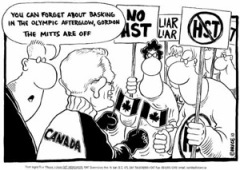
Vander Zalm and colleagues should be proud of taking the fight against the HST into the public sphere.

I say three cheers for Bill Vander Zalm and his fight against the HST! He and his colleagues have a Herculean task before them in trying to get the HST removed, but they have my support. It’s said that Vander Zalm ought to retire from the public scene. People who say that sort of thing are mad at the message and want to shoot the messenger. Read the full article in The Tyee: Fighting a Good Fight, Against the Odds

Time for a New BC Party?

Cartoon by Ingrid Rice.If NDP can’t win voters in middle, maybe someone else should try.

One of the real downers in this business is having to criticize, if not dump on, people you like. And politicians, like most people, are pretty nice people who are trying to do a good job.

However, I don’t think Carole James can become premier — and the NDP will, unless I miss my guess, come to the same decision before the next election.

Hard to be leader

It’s not easy to lead the NDP. While all parties have a left and right and centre to them, the NDP have factions which remain factions no matter what. I’ve used this example before, so forgive me, but you would never see the Liberals ask Jimmy Pattison to give the keynote address at a convention. If they did, no matter what Pattison said, it would be easy to say, “There they go, the Liberals are kissing the backsides of big business again”.

They will do handstands to make sure that their speaker, though a supporter of the party, doesn’t divide the party or scare the pants off the voter. One of the big reasons for this is that while Campbell relies on Big Business for his money, high-profile business people know that their job is to write cheques, not make speeches.

On the other hand, the NDP simply must have someone from one of the factions that make up the party speak at their convention, which leaves them open to “there they go again, kowtowing to Labour, or the teachers, or the fuzzy red intellectuals” or whatever. Continue Reading »

The tar sands and us

The Athabasca Tar Sands - credit: Wikimedia CommonsExcerpt: “What madness this all is! Wasn’t the idea that we’d wean ourselves off oil and concentrate our efforts and our money on substitutes? Can’t we see that by extracting oil that can only be viable if the price of oil is near $100 a barrel that we’re in fact making the high price of oil a self-fulfilling prophecy?”

Read the full story at The Common Sense Canadian – click here.

« Newer Posts - Older Posts »